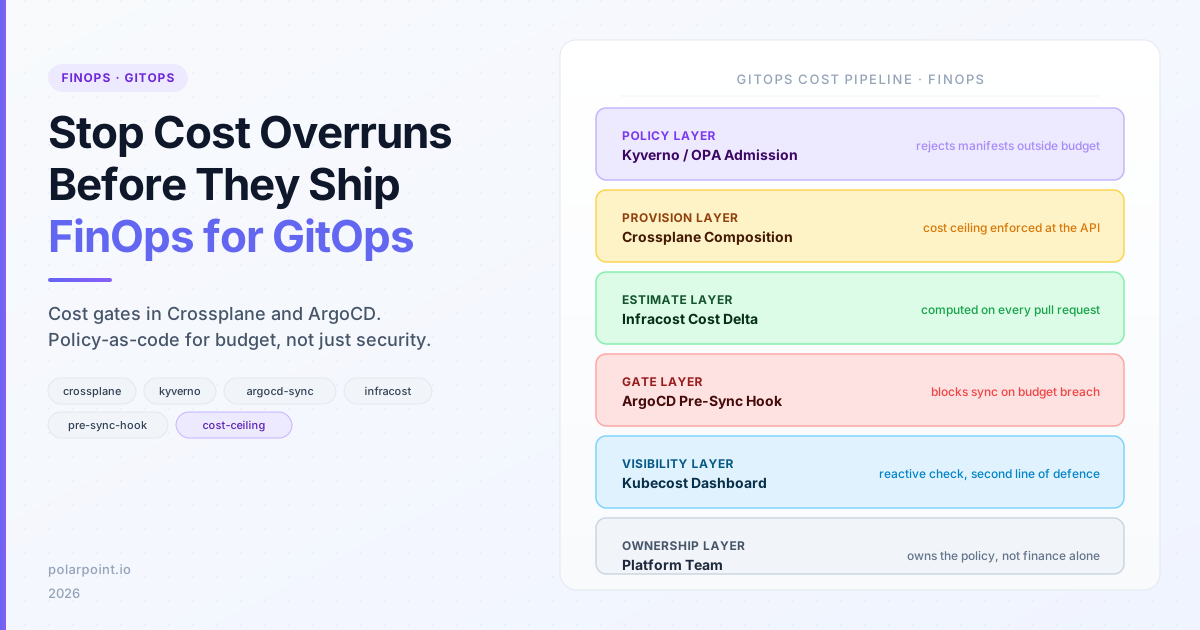
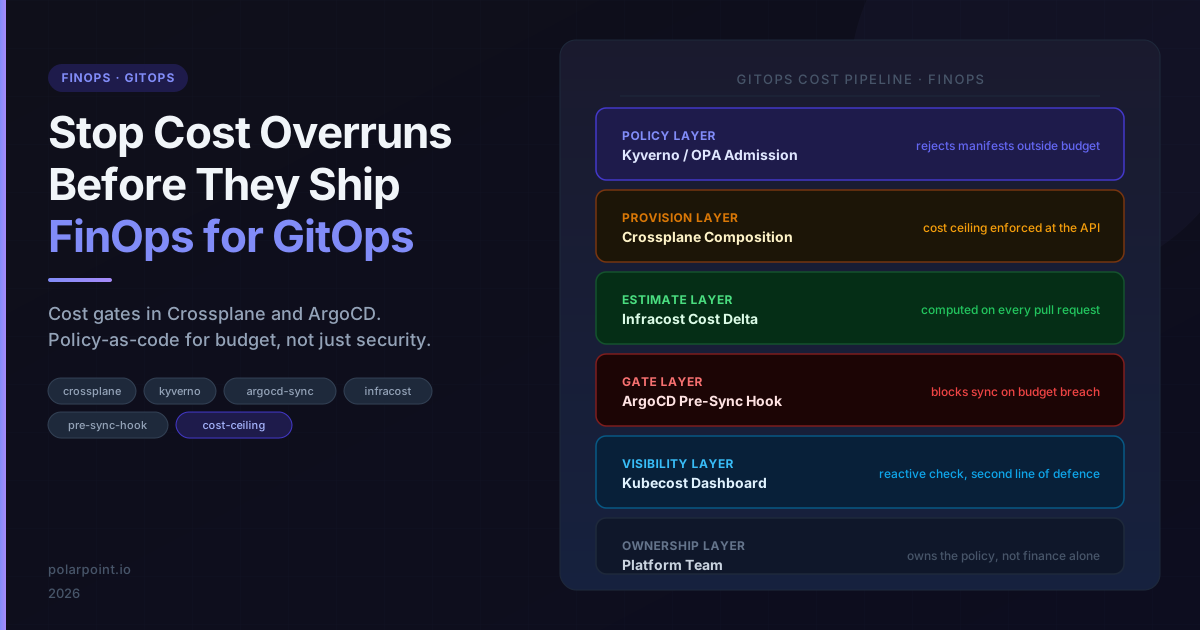
FinOps for Platforms: Stop Cost Overruns Before They Ship
An ArgoCD ApplicationSet spun up a preview environment for a pull request back in March. The PR closed in April. Nobody deleted the environment, because nothing was watching for that — it just kept running, quietly billing, until someone noticed a line item in June and had to go figure out what "pr-4471-preview" even was.
That's not a story about a careless team. It's what happens by default when cost isn't something your pipeline enforces, only something a dashboard reports on after the fact. By the time a cost anomaly shows up on a chart, the money's already spent. The only question left is how long it takes someone to notice.
Where FinOps is actually heading in 2026
The FinOps Foundation's own guidance has shifted from "give teams visibility" to "give teams a gate." Cost checks are moving earlier — into the pull request, into the composition, into the admission controller — the same place security and compliance checks already live. Dashboards aren't going away, but they're becoming the second line of defence, not the first.
Why dashboards catch cost problems too late
Kubecost-style tools are good at telling you what already happened. They're bad at stopping it from happening in the first place. That gap between spend and detection is often days, sometimes a full billing cycle, and in that gap an oversized RDS instance from a misconfigured Crossplane composition or a stale preview environment can run up a bill nobody planned for.
The preview-environment story at the top of this post is the pattern, not the exception. Anything that gets provisioned automatically and torn down manually is a cost leak waiting to happen, because "manually" means "only if someone remembers." We've covered the reactive side of this before in AI for FinOps, anomaly detection and fix PRs after spend has already happened. Everything below is about closing the gap before that spend ships at all.
The detection lag tell
If your cost anomaly detection runs on a weekly or monthly cadence, you're not preventing overspend — you're doing forensics on it. The fix isn't a faster dashboard. It's moving the check to before the resource exists.
Where cost guardrails belong in a GitOps pipeline
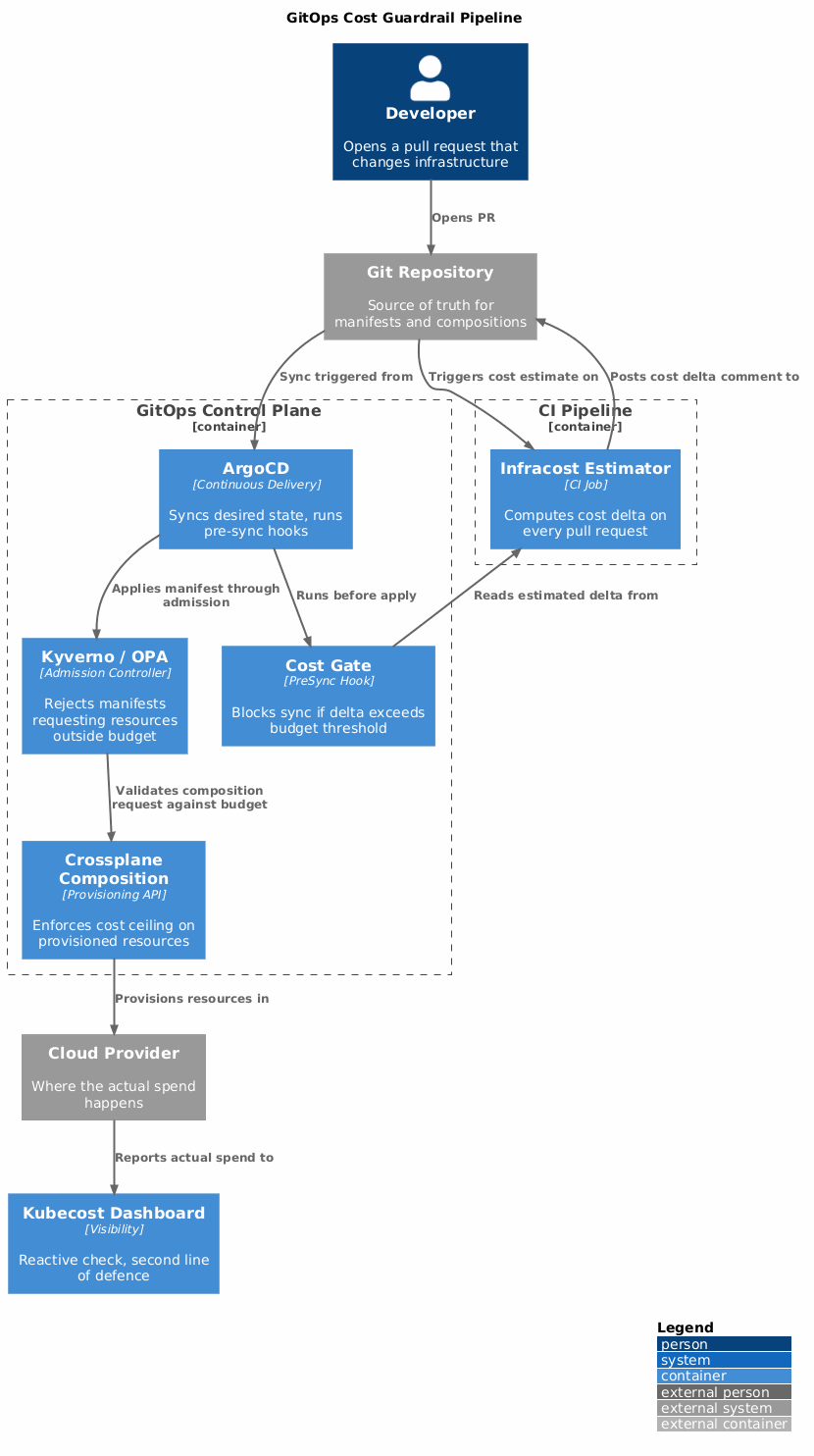
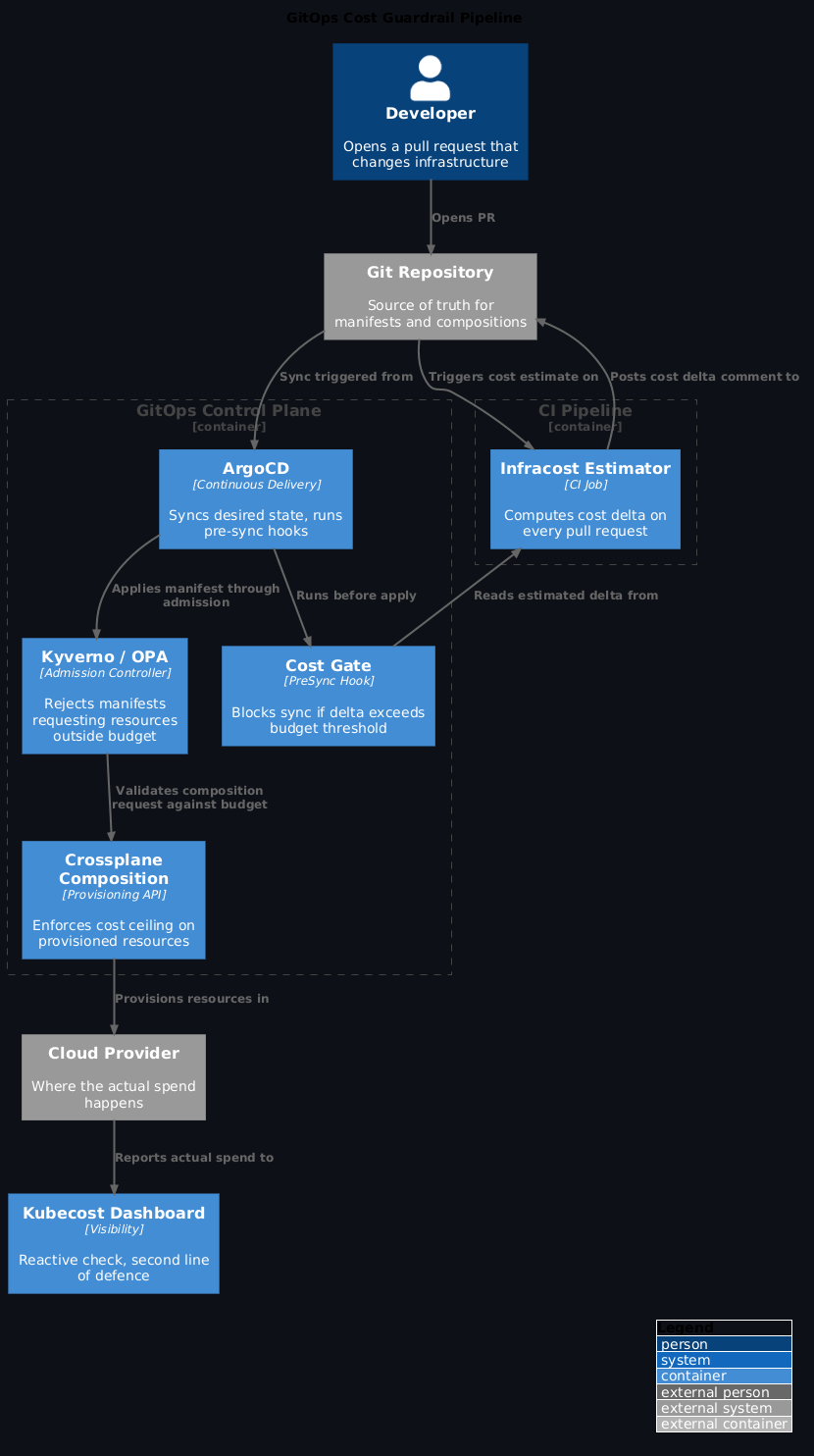
Cost policy needs to live in the same layer as the rest of your platform policy: the Crossplane composition, or the admission controller, not a separate FinOps tool bolted on after the fact. Kyverno or OPA can already reject a manifest that's missing a resource limit. There's no reason the same admission check can't reject a manifest that requests an instance type or replica count outside a defined budget.
This isn't a new category of tooling. It's the existing policy-as-code layer doing one more job. If your team already treats policy-as-code as the enforcement mechanism for GitOps, cost is just another policy to add, not a new system to stand up.
Start with the policy you already trust
If Kyverno already enforces resource limits in your cluster, extending that same policy set to cover instance types and replica ceilings is a smaller lift than it sounds. You're adding rules to infrastructure that's already running, not deploying something new.
Building a pre-deploy cost gate with ArgoCD
The mechanics: run a cost estimation tool like Infracost against every pull request, and wire the result into ArgoCD as a pre-sync hook that blocks the deployment if the estimated delta crosses a threshold. A soft version posts the estimate as a PR comment and lets the team decide. A hard version fails the sync outright.
# Illustrative ArgoCD PreSync hook — checks a cost-delta
# annotation set by an earlier CI step and fails the sync
# if it exceeds the configured budget threshold
apiVersion: batch/v1
kind: Job
metadata:
  name: cost-gate-check
  annotations:
    argocd.argoproj.io/hook: PreSync
    argocd.argoproj.io/hook-delete-policy: HookSucceeded
spec:
  template:
    spec:
      containers:
        - name: cost-gate
          image: internal/cost-gate:latest
          env:
            - name: MAX_MONTHLY_DELTA_USD
              value: "500"
      restartPolicy: Never
Most teams don't start with a hard gate on everything. Start with a soft warning, watch how often it fires, and promote it to a hard block once you trust the estimate.
Soft gate first, hard gate second
A hard gate that fires on a bad estimate is how platform teams lose trust in FinOps tooling fast. Run soft for a few weeks, tune the estimator against real bills, then flip to enforce.
What platform teams get wrong about FinOps ownership
The most common mistake is treating FinOps as a finance team problem instead of a platform capability. Finance can set the budget. They can't write the Kyverno policy that enforces it, and they shouldn't have to. That has to sit with the team that already owns admission control and composition design.
The second mistake is centralizing the policy without giving product teams visibility into their own spend before they merge. That doesn't remove the friction, it just moves it — now a team finds out their deployment is blocked with no idea why, instead of finding out from a surprise invoice. Either way, they're debugging cost after the fact.
Ownership, not enforcement, is the hard part
Writing the policy is the easy half. Deciding who owns it, who can grant exceptions, and who gets paged when it fires is the part that actually determines whether this survives contact with a real org chart.
Rolling this out without slowing delivery down
Start with warnings, not blocks. Scope the first gate to your highest-cost resource types only, things like GPU nodes and large database instances, rather than trying to cover every resource type on day one. And give teams a self-service way to request a budget exception, with an audit trail, so the answer to "this is a false positive" isn't a Slack message to the platform team every time.
None of this has to slow anyone down if it's built right. A gate that only fires on genuinely oversized requests is invisible to the ninety percent of deployments that were never going to be a problem.
FAQ
What's the difference between FinOps and a cost dashboard?
A cost dashboard reports what already happened. FinOps, done well, is the discipline of making cost a decision criterion at the point where the resource gets created, not just something you review after the invoice lands.
Can Crossplane enforce a cost budget directly?
Crossplane doesn't enforce a budget natively. A composition function can reject or modify a claim that requests resources outside a defined budget, the same way it already enforces naming conventions or required labels.
How do you estimate cloud cost before a deployment merges?
Tools like Infracost parse your Terraform or Kubernetes manifests and estimate the cost delta against your current state, without actually provisioning anything. That estimate is what a pre-sync hook checks against your threshold.
Does adding cost gates slow down deployments?
Only if you scope them badly. A gate that checks every field on every manifest will be slow and noisy. A gate that only checks the handful of resource types responsible for most of your spend barely adds any latency at all.
That preview environment from March is still the cheapest example in this post — most cost leaks aren't that visible. The point of a guardrail isn't to catch the one you'd have noticed anyway. It's to catch the one that would have run quietly until the next quarterly review.