GitOps as a Product: Building Self‑Service with ArgoCD
Every platform team reaches the same inflection point. The Kubernetes clusters are stable, GitOps is working, ArgoCD is syncing everything cleanly — and then a developer submits a ticket asking the platform team to onboard their new service. Then another. Then a queue forms.
You've built good infrastructure. But it's not a product yet. It's a service that requires the platform team to be in the loop for every new workload. That doesn't scale, and it creates exactly the kind of toil that drains platform engineers and slows down everyone else.
The fix isn't to work faster. It's to make onboarding something developers can do themselves — within guardrails the platform team controls.
The platform team's job shifts — not shrinks
Self-service GitOps doesn't reduce the platform team's role. It redefines it: from "onboard this service" (reactive, repeatable, manual) to "maintain the templates and policies that make onboarding safe" (proactive, scalable, high-value). That's a better use of a platform engineer's time.
What self-service GitOps actually means
Self-service doesn't mean developers get unrestricted access to the cluster. It means developers can get their service running without filing a ticket, as long as they stay within the boundaries the platform defines.
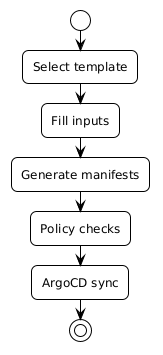
The practical model: a service catalogue where developers pick a template for their service type (API, worker, scheduled job), fill in the parameters specific to their service, and get back a complete GitOps-ready configuration that ArgoCD can sync. No custom YAML, no platform ticket, no waiting.
The platform team's job shifts from "onboard this service" to "maintain the templates and policies that make onboarding safe". That's a much better use of their time.

The three-layer model
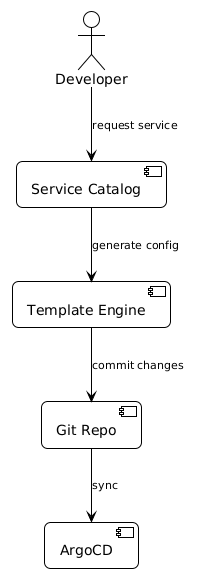
The approach has three components that work together.
Service catalogue — the entry point for developers. In practice this can be a Backstage software template, a simple web form, or even a well-structured GitHub Action with inputs. The catalogue defines what parameters a developer provides: service name, team, language, environment targets, resource requests. Everything else is standardised.
ApplicationSet templates — the catalogue input feeds into an ApplicationSet template that generates the ArgoCD Application resources. Developers don't write YAML directly. The template produces consistent, policy-compliant configuration every time. The service name becomes the ArgoCD application name, the resource requests slot into pre-defined size tiers, the environments are derived from what the team is allowed to deploy to.
Policy-as-code guardrails — Kyverno or OPA policies run on the generated manifests before ArgoCD syncs them. The policy layer is where "self-service" doesn't mean "anything goes". Teams can't accidentally request a pod with no resource limits. Naming conventions are enforced. Required labels (team, cost-centre, environment) are validated. If the generated config violates policy, ArgoCD flags it before it reaches the cluster.

What the template looks like
An ApplicationSet with a Git generator reading team configuration files is the common starting point:
apiVersion: argoproj.io/v1alpha1
kind: ApplicationSet
metadata:
  name: team-services
  namespace: argocd
spec:
  generators:
    - git:
        repoURL: https://github.com/your-org/platform-config
        revision: HEAD
        files:
          - path: "teams/*/services/*.yaml"
  template:
    metadata:
      name: '{{service.name}}-{{environment}}'
    spec:
      project: '{{team.name}}'
      source:
        repoURL: https://github.com/your-org/platform-config
        targetRevision: HEAD
        path: 'templates/{{service.type}}'
        helm:
          values: |
            service:
              name: {{service.name}}
              image: {{service.image}}
              replicas: {{service.replicas | default 2}}
            resources:
              tier: {{service.resourceTier | default "standard"}}
      destination:
        server: '{{cluster.server}}'
        namespace: '{{team.name}}-{{environment}}'
      syncPolicy:
        automated:
          prune: true
          selfHeal: true
A developer onboards by adding a YAML file under teams/their-team/services/. That file becomes the source of truth for their service's configuration. They update it via PR. The ApplicationSet picks up the change and syncs.
The policy friction tell
Policies that reject valid configurations because of minor formatting differences, or policies so strict that developers need exceptions on day one, kill self-service adoption faster than any technical problem. Keep the policy list focused on things that genuinely matter — resource limits, image registry restrictions, required labels — and nothing else.
Guardrails that don't get in the way
The policy layer is where most self-service implementations either get it right or create friction that kills adoption. The goal is policies that catch genuine problems without blocking developers who are doing the right thing.
The policies worth enforcing automatically:
Resource limits are required. Every container must have CPU and memory limits set — non-negotiable, this prevents noisy neighbour problems that affect everyone else on the cluster.
Team labels are required. team, environment, and cost-centre labels on every deployment. These power the chargebacks, the alerts, and the ownership queries.
Image registries are restricted. Images must come from your internal registry or an approved external source. No latest tags in production.
Namespace access is scoped. Each team's applications deploy to namespaces scoped to their team. Cross-namespace access requires an explicit exception.
What you don't want: policies that reject valid configurations because of minor formatting differences, or policies so strict that developers end up asking for exceptions on day one. Keep the policy list short and focused on things that actually matter for security and reliability.
The developer experience
When this is working well, a developer joining a new team can have their first service running in production within a day. They find the catalogue, pick the service template that matches what they're building, fill in their service name and repository URL, open a PR to the platform config repo, get it reviewed and merged. ArgoCD picks it up and syncs. Done.
No Slack message to the platform team. No ticket. No waiting.
For the platform team, every new service is consistent. Resource limits are always there. Labels are always there. The namespace is always right. The things they used to manually verify on every onboarding ticket are just... always correct.
That's the compound value. Not just that onboarding is faster for developers, but that the platform team gets confidence back. They're not approving every onboarding because they have to — they're free to focus on the harder infrastructure work because the routine stuff is handled.
Apply this: validate before you commit
Add the validate-service.py script to your CI pipeline as a required check. Every PR that adds or modifies a service definition gets validated against your policies before it can merge. Developers get fast feedback without waiting for ArgoCD to surface the error post-sync.
The working code
The companion repo has a complete example with the three-layer model — service catalogue schema, ApplicationSet with matrix generators, and Kyverno validation. There's also a validate-service.py script for CI validation and a new-service.py scaffolder for generating definitions interactively.
→ argocd-self-service example + scripts
# Scaffold a new service definition
python scripts/gitops/new-service.py \
  --team payments \
  --type api-service \
  --output teams/payments/services/

# Validate before committing
python scripts/gitops/validate-service.py \
  --file teams/payments/services/payments-api.yaml
Frequently asked questions
How do you prevent developers from editing files outside their team's directory?
CODEOWNERS files and branch protection rules. Configure CODEOWNERS so that teams/payments/** requires approval from the payments team, and templates/** requires platform team approval. Developers can only onboard services in their own team directory; template changes require platform review.
What's the right level of abstraction in service templates — too thin vs too opaque?
Too thin: developers still need to understand Helm, ArgoCD Application resources, and Kubernetes manifest structure. Too opaque: developers can't debug when things go wrong. The right level: developers provide service name, image, team, resource tier, and environments. Everything else is derived. They shouldn't need to know what an ApplicationSet is.
Can teams deploy to multiple environments from a single service definition file?
Yes — include an environments list in the service YAML and use a matrix ApplicationSet generator that fans out across both the cluster generator and the environments list. Each combination (service × environment) produces one ArgoCD Application. One file, multiple environment deployments.
What happens when a developer submits a service definition that fails Kyverno validation?
ArgoCD surfaces a sync error with the Kyverno policy violation message. The service doesn't deploy. The developer sees the specific policy that failed and what value violated it. With the CI validation script, this feedback happens at PR time rather than post-merge — much cheaper to fix early.
How do you handle database provisioning as part of self-service onboarding?
Extend the service template to include an optional database block. When present, the ApplicationSet generates an additional Crossplane Database claim alongside the deployment. The service gets the database connection secret mounted automatically via ESO. Developers declare intent; the platform provisions the resource. See the Crossplane v2 post for the composition pattern.